ODES-lab Research: Polymer Physics
Featuring stretched polymer physics, extensional rheology & processability
macromolecular properties: flexibility, extensibility, & segmental dissymmetry | spinnability & stringiness |
interactions: excluded volume, hydrophobic, topological, hydrodynamic, or electrostatic
STRETCHED POLYMER PHYSICS
Role of Excluded Volume, Hydrophobic, Topological and/ or Hydrodynamic Interactions
We enabled detailed characterization of the influence of polymer additives in solutions and formulations by developing dripping-onto-substrate (DoS) rheometry protocols that rely on visualizing and analyzing capillarity-driven pinching of liquid necks.
Contributions
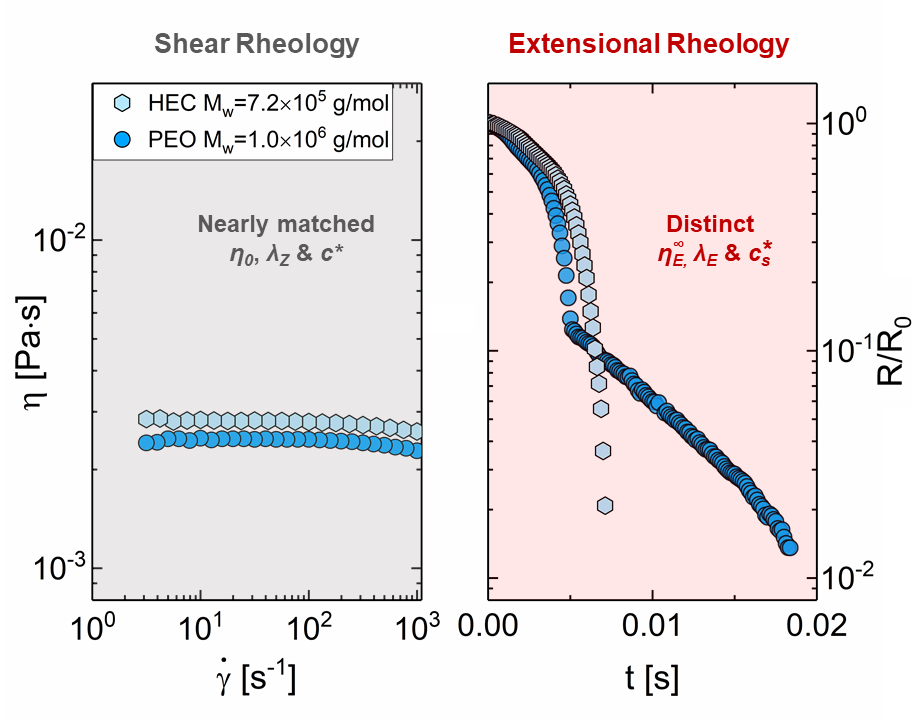
Extensional relaxation time shows concentration-dependent variations that are quite distinct from shear relaxation time, which are not anticipated by single-chain models in the dilute limit or blob models in semi-dilute solutions, which were developed for the relaxation of weakly perturbed or unperturbed chains.
For neutral polymers, we identified a stretched overlap concentration below which the extensional relaxation time is concentration-independent, and we carried out extensive extensional rheology measurements on semi-dilute, unentangled solutions. We found entangled polymer solutions can display power-law pinching before elastocapillary response is observed.
We showed that the influence of polymer choice could be evaluated a priori, using three macromolecular parameters: flexibility, extensibility, and segmental dissymmetry, defined as the ratio of packing length to Kuhn length.
POLYELECTROLYTES
Electrostatic and hydrophobic interactions. Influence of solvent and salt.
Shear, extensional, and interfacial rheology of proteins and charged polymers.
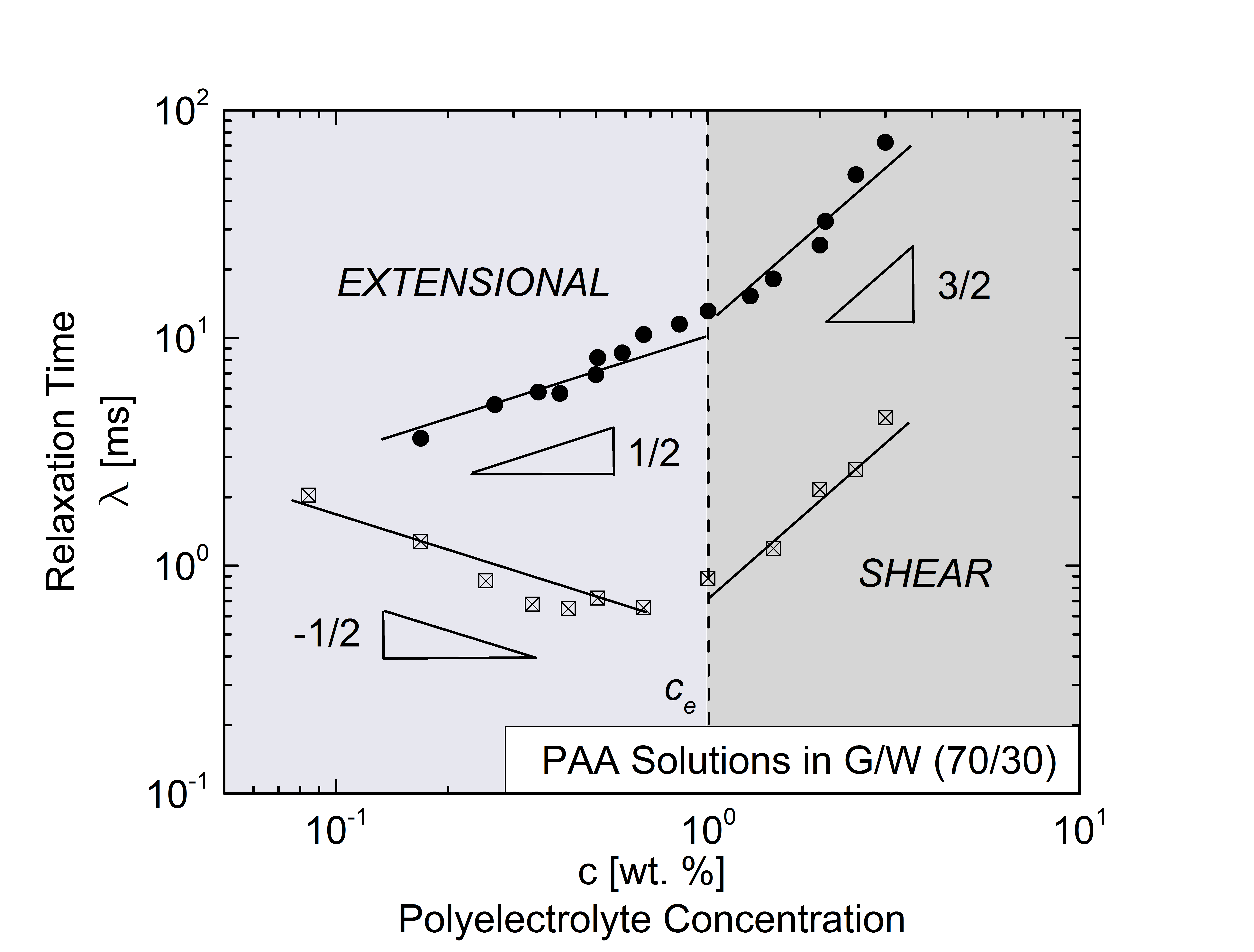
We presented the first comprehensive examination of the extensional rheology response of semi-dilute polyelectrolyte solutions, and found that the extensional relaxation time typically increases with concentration, with exponents distinct from those displayed by shear relaxation time.
We discovered that in glycerol/water solutions, the enhanced solvent viscosity effects do not transfer to solution shear viscosity as increasing glycerol concentration weakens the electrostatic interactions, mimicking the influence of added salt.
Graphic Abstract for Extensional Relaxation Time, Pinch-off Dynamics and Printability of Semi-Dilute Polyelectrolyte Solutions, L. N. Jimenez, J. Dinic, N. Parsi and V. Sharma*, Macromolecules, 51, 5191-5208 (2018). ExtensionalRheologySaltfreeSemidilutePolyelectrolyteSolutions
FIBER SCIENCE & ENGINEERING
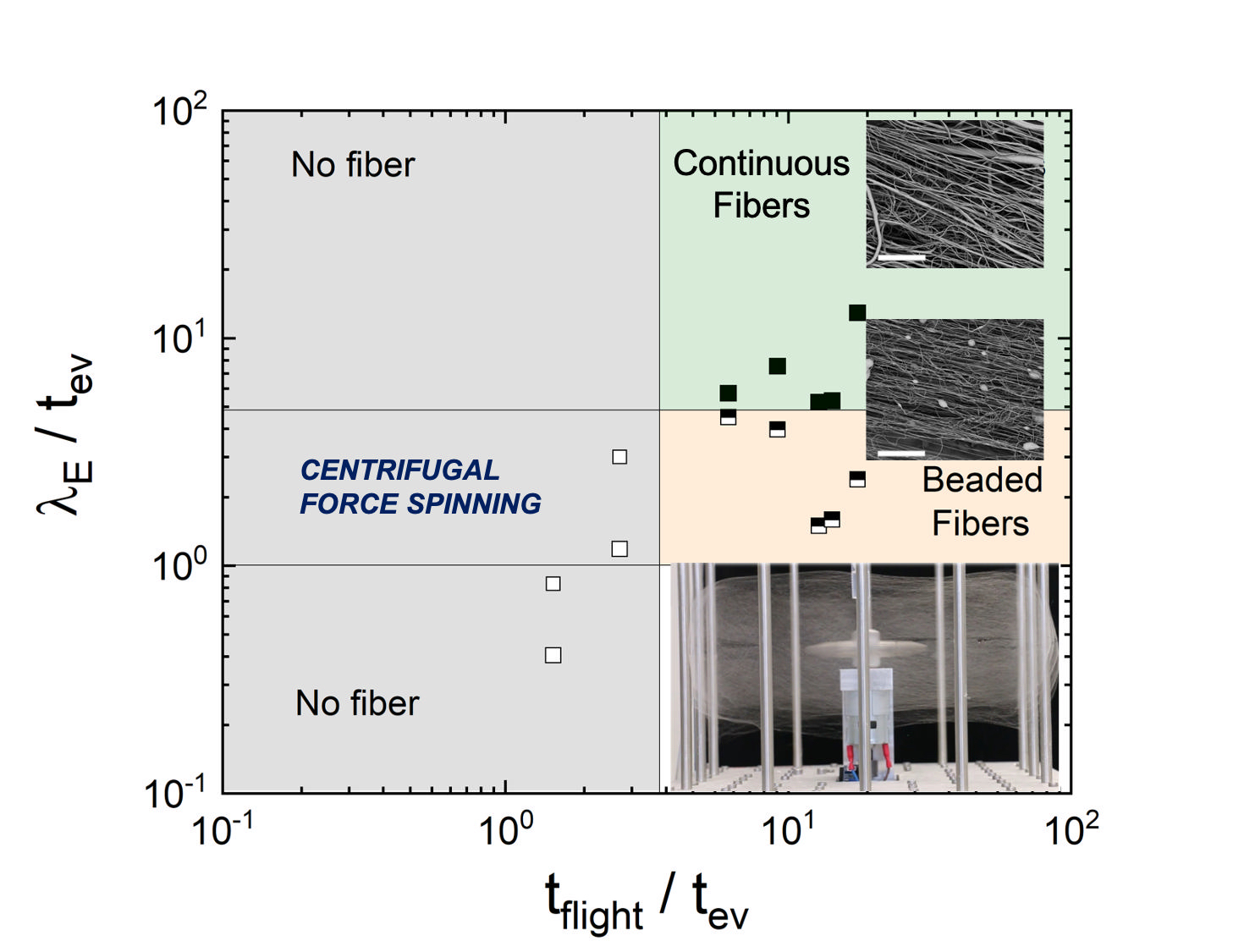
Centrifugal force spinning | Spinnability | Macromolecular engineering of fiber properties | Membrane engineering
Making fibers using “the cotton candy” process.
Extensibility-enriched spinnability. Volatile-entangled spinnability.
Mechanical properties and crystallinity of fibers. Sorption.
See publications connecting our rheology and polymer physics ideas to centrifugal force spinning research carried out by our collaborators (formerly in the University of Hasselt, Belgium): Jorgo Merchiers (who finished his Ph.D. in 2021) and his advisor, Naveen Reddy. We identified two distinct mechanisms underlying spinnability: volatile-entangled and extensibility-enriched.